
 DODGE PREFERS YOU NOT
CALL IT A NEON.
DODGE PREFERS YOU NOT
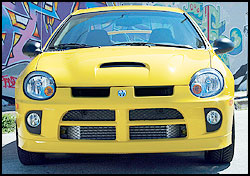
CALL IT A NEON. No predestined quality knocks, no under-powered jelly bean references. Leave the remarks for R/T or SXT editions. This race-tuned edition, in theory, is as much a Neon as the RSX is a Civic. Dodge’s Performance Vehicle Operations took enough hiatus from building SRT-10s and an SVT Lightning-beater to rip the badges off a Neon, plop on a wing, cut a nostril in the hood and call it SRT-4. The result may not be America’s first legit tuner, as Chrysler execs insist, but it is a homebred pocket rocket to challenge (and outmuscle) the SVT Focus at less than $20,000.
As with the SVT Focus, aesthetics and nomenclature are the starting line, sort of a national anthem including interior upgrades, boost gauge, well-bolstered seats and plastic replaced with satin finishes.
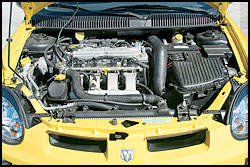
The actual ball game commences with the 16-valve, dohc 2.4-liter turbo four found in the PT Turbo, bumping this Neon’s output to 215 hp at 5200 rpm and 245 lb-ft between 3200 and 4200 rpm. With near-WRX power going only to the front axle, plenty of wheelspin is available in nearly all gears to accompany an estimated 0-to-60-mph time of less than six seconds.
2003 DODGE SRT-4 |
|
Straightaway performance and bang-per-liter are great, but not
unbelievable. Mitsubishi—supplier of Dodge’s turbocharger—can
squeeze 135.5 hp per liter and 136.5 lb-ft per liter out of the Lancer
Evolution’s 2.0-liter turbo four and Chrysler turned out legitimate
small turbos (GLHS anyone?) prior to the Daimler deal. Nevertheless, Dodge
has crafted a phenomenal proclamation to say it’s back in the game.
Although we liked the PT Turbo, we knew we’d have to wait for the
race-tuned econobox to experience the powerplant’s potential. The
SRT-4’s mill has been mated to a new heavy-duty five-speed manual that
beats the heck out of anything negotiating Neon power before. The shifter
was slightly notchy, but offered relatively short throws, while clutch
engagement was extraordinarily smooth. The overall package is a few
strokes ahead of Subaru WRX; on par with the SVT Focus.
|
With its SRT-4, Dodge has crafted a phenomenal proclamation to say it’s back in the game. |
The SRT-4 feels stiffer and more stable than most in its class, lacking
the abrupt wheel jerk that plagues many torque-happy front-drivers. As
opposed to the PT, overboosted feel or vagueness when cornering were nil;
instead the appropriately taut steering suggests the car spent time in the
Viper’s garage. Whereas many "sport-tuned" suspensions exhibit
body roll and understeer needed for a smooth ride, PVO engineers scrapped
smooth—furthering the Viper argument—and produced a suspension that
soaks up potholes as well as wooden snow skis soak up moguls.
The SRT-4 has an exhaust note tuned to reflect Dodge’s muscle heritage.
It would strike the non-enthusiast as obtrusive. Ironically, whereas the
PT Turbo’s exhaust tone is drowned out by the turbo, the opposite is the
case with this car. Rally-bred turbo fours often sound like an overworked
appliance, but this sounds like a tough-talking bully.
 A limited-slip differential doesn’t come standard, an acceptable
omission when the sticker reads $19,995, and only a penalty if you’re
dodging through a cone-cluttered parking lot. Even under casual driving
conditions, the car feels heavy-duty, thanks to beefed-up springs, shocks,
antiroll bars and steering knuckles. Take this car to a sloppy road, drive
it fast and it stays on the road and in control.
A limited-slip differential doesn’t come standard, an acceptable
omission when the sticker reads $19,995, and only a penalty if you’re
dodging through a cone-cluttered parking lot. Even under casual driving
conditions, the car feels heavy-duty, thanks to beefed-up springs, shocks,
antiroll bars and steering knuckles. Take this car to a sloppy road, drive
it fast and it stays on the road and in control.
Cindy Krolikowski, a WRX co-driver in SCCA ProRally, drove a PVO project
SRT-4 in Washington state’s tree-lined woods last year. Krolikowski
notes oversteer on command thanks to the alignment setup, which is a
factor rally drivers can appreciate—still a bit tedious for casual
drivers who aren’t used to a loose rear end.
Krolikowski sensed no brake fade even under harsh conditions, neither did
we. Standard Neon front discs with single-piston sliding calipers dressed
our tester, yet the rear discs are 25 percent bigger and the swept brake
area more than doubled.
|
As with the SVT Focus, aesthetics and nomenclature are the starting line, sort of a national anthem including interior upgrades, boost gauge, well-bolstered seats and plastic replaced with satin finishes. |
Somewhat fortunately, our first SRT-4 voyage came not on a track, but with
a knee on the pavement. We shredded a tire entering an on-ramp minutes
from the office—bad for the front passenger-side 205/50R Michelin Pilot
tread, good for inspection purposes. Overall fit-and-finish checked out
well, as did body panel sturdiness. Chances are, PVO standards are as
stringent as it gets in Auburn Hills in order to preserve a burgeoning
reputation.
Unfortunately, we weren’t two days into a one-week test when the
check-engine light flickered and we sent this little bullet back to Dodge,
flagging the biggest concern readers have with the car: durability. The
problem was a disconnected throttle sensor cable.
Of course one week in a car and one engine-warning light is no real
measure of durability. We’ll have to order up a couple of more PVO Neons,
er SRT-4s, to be sure.